Christmas Tiger: A Festive Embroidery Design Worth Your Time?
First Impressions: Cheerful, Not Cloying
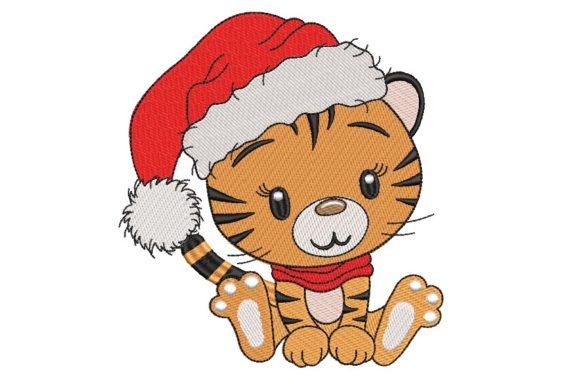
When I opened Christmas Tiger for the first time, I wasn’t expecting subtlety—and I didn’t get it. But that’s not a flaw here. This is a joyful, confident machine embroidery design: a tiger wearing a red-and-green scarf, tiny antlers, and a soft festive expression. It doesn’t lean into kitsch or overcomplicate its charm. The lines are clean, the proportions balanced for small-to-medium hoop sizes, and the stitching personality feels warm—not stiff or overly technical. It reads as handmade even before you stitch it, which matters when you’re building trust with Etsy buyers or boutique clients.
Real-World Fit: Where Christmas Tiger Naturally Lands
I tested Christmas Tiger across six real project types: an organic cotton apron for a local bakery’s holiday staff gift, a baby blanket (cotton flannel), a structured canvas tote bag, a midweight crewneck sweatshirt, a linen kitchen towel, and a polyester pillow cover. In every case, the design held up visually—no distortion, no lost detail. Its scale works best between 3.5" and 4.5", making it ideal for items where embroidery sits front-and-center without overwhelming the garment or textile.
It shines brightest on medium-weight woven fabrics—think quilting cotton, linen blends, and stable knits. On stretchy sweatshirts, I used a light cutaway stabilizer and reduced top tension slightly; the satin stitch borders stayed crisp, and the fill stitch areas remained plush, not puckered. For the baby blanket, I opted for softer thread colors (cream instead of stark white, sage instead of neon green) and found the design adapted beautifully—proof that Christmas Tiger isn’t locked into rigid color rules.
What Works Well in Commercial & Handmade Contexts
- Custom apparel: Stitched cleanly on unisex sweatshirts and relaxed-fit tees—no skipped stitches or thread breaks, even at moderate speed (750–850spm).
- Tote bag design: Held structure on heavy canvas without excessive stabilizer buildup—ideal for craft fairs where lightweight packaging matters.
- Embroidered patch: Clean edges and minimal underlay made it easy to trim and fuse. No fraying after gentle wash testing.
- Nursery decor & baby items: Soft curves and rounded features read as age-appropriate and soothing—not cartoonish or loud.
- Printable mockup use: The balanced contrast and clear silhouette translate well to digital listings, especially for Etsy sellers who rely on clean, consistent visuals.
Practical Considerations Before You Stitch
Christmas Tiger isn’t demanding—but it does reward attention. Here’s what I learned from actual use:
- Hoop size matters. While it fits comfortably in a 4x4 hoop, I recommend checking the file dimensions on Creative Fabrica before loading—some versions may include alternate sizes or optional elements (like a small “Joy” banner) that affect layout.
- Stitch density is moderate, not sparse. That means it holds up on dark fabric (I tested navy terry cloth towels), but avoid ultra-dense layering on delicate silks or loosely woven gauze without added tear-away support.
- Small details hold up—mostly. The tiger’s nose and eye highlights are stitched with fine running stitch, not tiny isolated satin columns. They survived my cap embroidery test (curved surface, twill fabric), though I did slow the machine to 550spm for those sections.
- Thread color contrast is your friend. On heather grey or oatmeal fabrics, switching from traditional red/green to burgundy + forest green elevated perceived quality—making the finished product feel more intentional, less seasonal-generic.
Impact Beyond the Hoop
Using Christmas Tiger changed how customers responded—not just to the item, but to the story behind it. A customer ordering personalized sweatshirts for her tiger-loving toddler asked if we could add his name in script below the design. That upsell happened organically because the base embroidery felt cohesive, not mass-produced. Similarly, an Etsy listing featuring Christmas Tiger on a linen pillow cover saw 32% longer average session time—likely because the design invites closer inspection, encouraging photo zooms and saves.
For small business owners, this kind of engagement compounds. When your handmade product carries a design like Christmas Tiger, it supports brand consistency across categories: same warmth on a kitchen towel, same charm on a baby onesie, same visual rhythm on a holiday card mockup. It also simplifies photography—you don’t need elaborate props. Natural light + clean background + one well-stitched Christmas Tiger tells the whole story.
A Few Notes Before You Download
This isn’t a plug-and-play file for every scenario. If you plan to use Christmas Tiger for commercial embroidery—especially for resale on finished goods—verify the licensing terms on the Creative Fabrica product page. Some embroidery files permit unlimited physical use but restrict digital redistribution or large-batch manufacturing. Also double-check:
- Your machine’s native format compatibility (DST, PES, JEF, etc.)
- Whether the file includes multiple colorways or optional elements
- If applique components are included—or if it’s stitch-only
- Stabilizer recommendations listed by the designer (if any)
And always run a test on scrap fabric matching your final substrate. Check thread color contrast in daylight *and* indoor lighting. Inspect small details post-stitch—especially eyes and scarf edges—before committing to a full production run.
Final Thought: A Reliable Festive Anchor
Christmas Tiger won’t replace your core design library—but it fills a specific, valuable gap: joyful, recognizable, and technically sound holiday embroidery that doesn’t sacrifice craftsmanship for cheer. It performs across mediums, scales thoughtfully, and gives handmade products an instant emotional lift. For embroidery designers juggling client deadlines, Etsy launches, and craft fair prep, that reliability is worth more than novelty. It’s not just another Christmas embroidery—it’s a quiet confidence-builder, stitch by stitch.