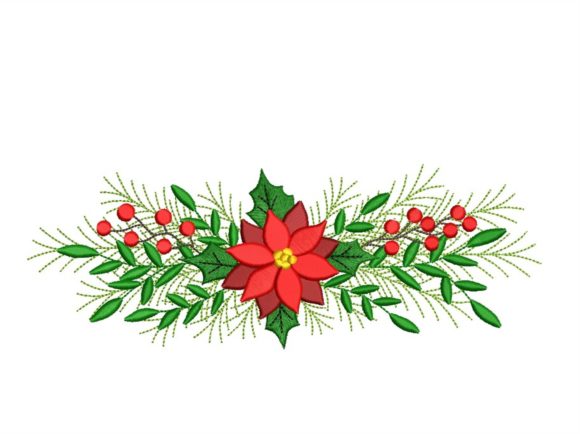
Christmas Poinsettia: Festive, Flexible & Fair-Ready
A Designer’s First Glance: Bold Yet Balanced Festivity
Right off the bat, Christmas Poinsettia lands as fresh, elegant, and unmistakably seasonal—no cliché snowmen or cartoon reindeer here. The name alone signals sophistication: poinsettias carry weight in holiday design language—they read as classic, botanical, and premium. It’s not overly rustic, not aggressively modern, and definitely not kitschy. That balance is gold for craft fair buyers who want handmade charm without sacrificing polish. When I see “fresh and festive” in the description, I trust it’s designed to breathe—not overwhelm—with clean petal shapes, intentional negative space, and a natural flow that translates beautifully across fabric types.
Where Christmas Poinsettia Shines on Craft Fair Products
This machine embroidery design thrives where craftsmanship meets clarity. Here’s how it performs across key small shop products:
- Tote bag design: A centered or lower-corner placement reads instantly from three feet away—ideal for booth browsing. The floral shape avoids looking “busy” even at 4–5 inches wide.
- Apron embroidery: Perfect above the pocket or along the bib edge. Its organic outline softens utilitarian fabric while elevating perceived value—customers consistently pay more for aprons with botanical motifs.
- Tea towel embroidery: Works brilliantly at 3.5–4.5 inches tall. On linen-cotton blends, the stitch definition holds up through washing, and the design feels intentional—not like an afterthought.
- Embroidered patch: Highly adaptable. Trimmed and heat-applied to denim jackets or market bags, Christmas Poinsettia adds instant holiday personality without requiring full-digitization.
- Pillow cover & pouch embroidery: Scales well as a focal point on 12x12" covers or as a subtle accent on zippered pouches. Its symmetry gives strong visual anchoring—critical when items sit flat on a table.
- Caps & curved surfaces: Proceed with caution. While possible, the petal layering may compress unpredictably on structured caps unless digitized specifically for curved hoops. Test first.
Production Realities: What Makes This Design Booth-Ready
Christmas Poinsettia earns its spot in my craft fair lineup because it’s intuitive—not just beautiful. At a glance, buyers understand what it is and why it matters. No decoding required. That’s rare. It works equally well as a small accent (e.g., 2.2" on a gift tag) or large statement (6" on a table runner), giving you flexibility across price points and inventory tiers.
Photographing Christmas Poinsettia for Etsy listings or social previews is straightforward: it pops against both light and dark backgrounds, especially with high-contrast thread colors (crimson red + ivory white, deep green + gold). Its shape lends itself to printable mockups—you’ll get clean, consistent visuals across your digital embroidery file listings without heavy editing.
For batch production? Yes—it’s repeatable. Moderate stitch density means stable running across machines, minimal thread breaks, and predictable hooping times. Just confirm the embroidery file includes clear color-separation notes so your team can match thread colors reliably across dozens of tote bags or tea towels.
Careful-Use Notes Every Embroidery Designer Should Check
Even lovely designs have limits. Before cutting into your best linen or pressing 50 patches, ask:
- Does the original embroidery file include dense fill areas in the center bracts? Overly tight stitching can pucker lightweight fabrics or obscure detail on textured towels.
- Are there tiny interior veins or micro-details? These often vanish on dark fabric or at sub-2.5" sizes—better suited for boutique-sized pillows than market bag accents.
- How does it behave on thick cotton duck or canvas? You’ll need cutaway stabilizer—not tear-away—to prevent distortion.
- Does the design rely on fine satin-stitch outlines? Those can blur on terry cloth or looped kitchen towels—test on your exact fabric before committing.
Why This Design Strengthens Your Booth & Brand
In a sea of glitter and garlands, Christmas Poinsettia stands out by feeling intentional—not trendy. It supports brand consistency whether you’re known for farmhouse simplicity or elevated handmade goods. On a crowded craft fair table, it draws attention without shouting: the reds feel warm but not aggressive, the greens rich but not overwhelming, and the overall shape invites touch and closer inspection.
It also lifts perceived value. Customers associate botanical embroidery with care and skill—especially when executed cleanly. A well-stitched Christmas Poinsettia on a linen apron tells buyers, “This wasn’t rushed. This was chosen.” That narrative fuels engagement, encourages questions at your booth, and increases conversion on higher-ticket items like pillow covers or custom totes.
Designer-to-Designer Checklist Before Production
Before sending Christmas Poinsettia to your hoop or uploading it to your Etsy shop, run through these non-negotiables:
- Test the embroidery file on scrap fabric matching your final product’s weight and texture.
- Verify thread contrast—especially on dark fabric. Ivory thread on navy linen? Gorgeous. But only if the stitch density allows it to read clearly.
- Review spacing between petals and leaves. Tight crowding creates tension; too much air weakens impact.
- Confirm hoop size compatibility with your most-used frames—and whether re-hooping is needed for larger versions.
- Inspect stitch density visually and physically. Run your finger over a test piece: does it feel smooth, or stiff and raised?
- Use the right stabilizer: cutaway for knits and heavy use, tear-away for lightweight linens, and fusible for patches.
- Create at least one real-world mockup—not just a digital preview. See how it drapes, folds, and catches light.
- Compare fabric colors side-by-side: red thread on burgundy fabric fades; on cream, it sings. Let the material guide your palette.
- Confirm commercial licensing terms before selling finished products. As an Etsy seller or small shop product maker, this protects your business and respects the designer’s work.
When you get those details right, Christmas Poinsettia isn’t just another holiday design—it becomes a reliable, revenue-driving craft fair product that customers remember, photograph, and come back for year after year.